Questions / Answer
Cisco Firewall Flaw: Continuous Monitoring and the November 1 Clock
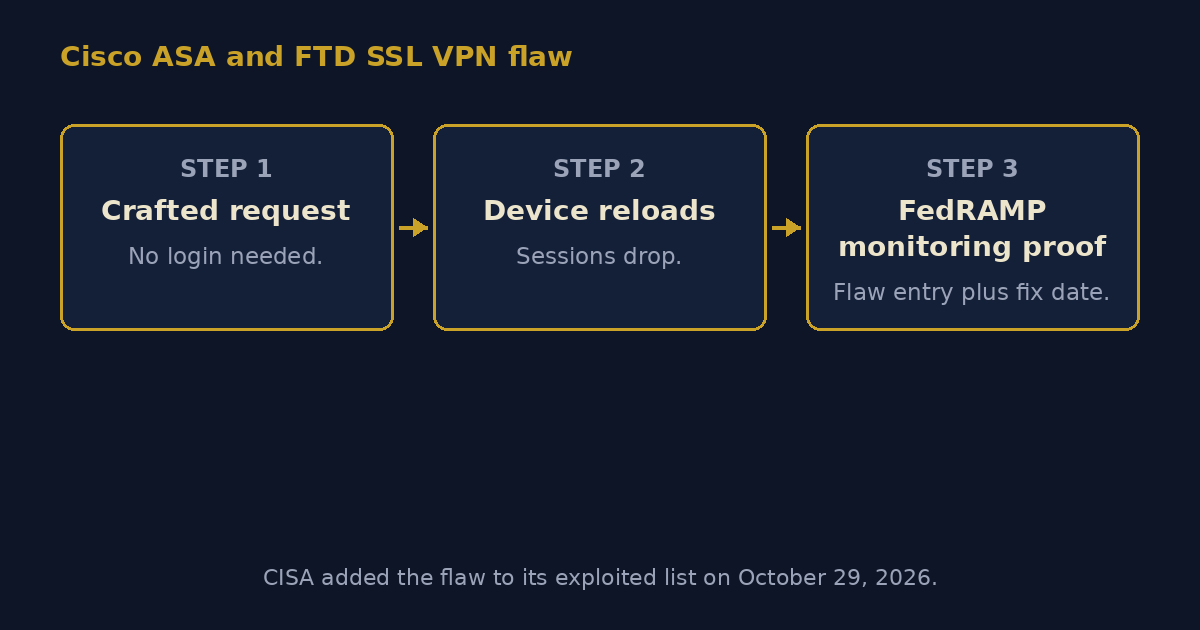
Continuous monitoring is a clock, not a folder. A new exploited flaw starts the clock. Your monitoring record must show the entry, the fix, and the date.
The flaw in plain words
Cisco published a security advisory on October 28, 2026. The advisory covers a flaw in the Remote Access SSL VPN service. The service runs on Cisco Secure Firewall Adaptive Security Appliance (ASA) Software. It also runs on Cisco Secure Firewall Threat Defense (FTD) Software.
The record is CVE-2026-76418. Common Vulnerabilities and Exposures (CVE) is the record system for public flaws. The score is 8.6 under Common Vulnerability Scoring System (CVSS). An unauthenticated attacker can force a vulnerable device to reload. Unauthenticated means the attacker needs no login first. The result is a denial of service. Sessions drop until the device returns.
The Cybersecurity and Infrastructure Security Agency added CVE-2026-76418 to its Known Exploited Vulnerabilities (KEV) Catalog on October 29, 2026. The catalog sets a November 1, 2026 due date for federal civilian agencies. That date is three days after the listing. Treat it as the pace to match, even when it does not bind you directly.
What is not reported
Cisco reports no confirmed data theft for this flaw. Cisco reports no remote code execution for this flaw. Remote code execution means running attacker code on the device. The confirmed impact is the crash itself, not a takeover. Do not open a deviation on a takeover that is not reported. Open the flaw entry on the crash that is reported.
What monitoring must show
First, the flaw entry, with the advisory date of October 28, 2026. Note the listing date of October 29, 2026 too. Second, the inventory of ASA and FTD devices in scope, with the running release on each one. Third, the exposure check for each device: SSL VPN reachable, and secondary authentication set on any tunnel group. Check the default tunnel group too. Fourth, the fixed release for each device after the patch. Fifth, the patch date and the scan result after the patch.
A device is exposed only when three conditions all hold. It runs a vulnerable release. Its SSL VPN login service is reachable. Secondary authentication is set in the tunnel group scope. A device that fails any one condition stays in the record as checked and cleared. That note is monitoring evidence too.
PolicyCortex does not patch Cisco devices. PolicyCortex helps teams link proof to requirements.
Sources
- CVE-2026-76418 record, CVE Program, score 8.6
- National Vulnerability Database (NVD) record for CVE-2026-76418
- Cisco security advisory, published October 28, 2026
- CISA alert, CISA Adds Two Known Exploited Vulnerabilities to Catalog, October 29, 2026
- Original diagram by PolicyCortex
Next step
Open the flaw entry for each in scope firewall and set its fix date.