Questions / Answer
Cursor Tampered Update Tests Supply Chain Incident Response
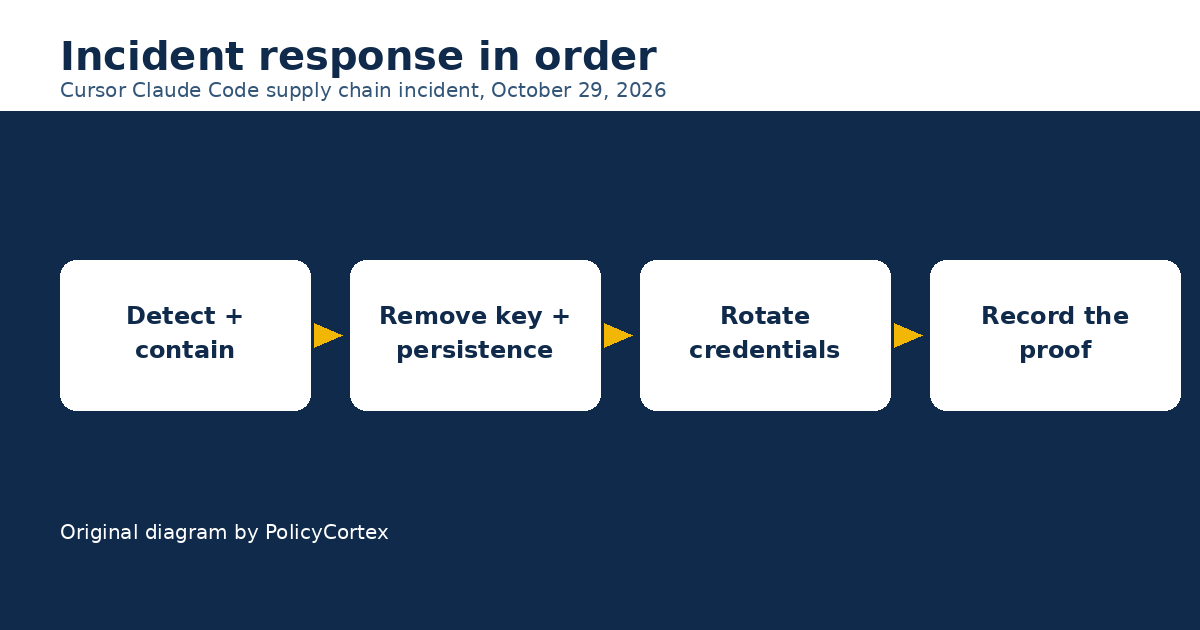
Incident response plans exist so a team acts in order, not from memory. This incident rewards that order. On October 29, 2026, a tampered Claude Code update reached Cursor users. The update used the name Anthropic.claude-code. It appeared in the Cursor Visual Studio Code (VS Code) Extension Marketplace. Versions 2.1.312 and 2.1.313 for Windows and macOS were affected. The window ran from about 2:27am to 1:35pm Pacific Time.
What the tampered build did
The code added an attacker Secure Shell (SSH) key to authorized_keys. The key carried the label svc-telemetry. It set up persistence through a macOS LaunchAgent or a Windows scheduled task. It sent host details to an attacker server. On most hosts the reverse tunnel step failed without admin rights. The key, the persistence, and the host report still happened. Cursor later took the attacker server offline with its hosting provider.
Response in order
First, detect. Name the hosts that installed or updated in the window. Second, contain. Isolate any host that shows the key or persistence. Third, eradicate. Remove the key, the persistence, and any tunnel process. Fourth, recover. Return the host to service only after a clean check. Fifth, learn. Record what the channel check missed and fix it. Skipping a step leaves a live artifact behind. Reordering the steps risks wiping proof before it is saved.
Why an update alone fails
A fresh extension version does not remove the attacker key. It does not remove the LaunchAgent or scheduled task. It does not close the tunnel process. Those artifacts live outside the extension folder. They keep running after the extension is gone. The response must name each artifact and clear it on purpose. A status of "updated" is not a status of "clean." The incident record must show the check for each artifact, host by host.
What the incident record must hold
The affected versions and the exposure window. The host list with a check result for each host. The key check, the persistence check, and the process check. The removal record for each artifact found. The credential rotation record for affected hosts. The date each step finished and who signed it off. A record with gaps will not survive review. A complete record turns a bad day into a closed incident.
PolicyCortex does not run incident response for customers. PolicyCortex helps teams link proof to requirements.
Sources
- Cursor security notice, updated October 30, 2026. https://cursor.com/blog/claude-code-extension-security-notice
- The Hacker News article, October 2026. https://thehackernews.com/2026/10/official-claude-code-vs-code-extension.html
- OpenSourceMalware research findings, as quoted by The Hacker News.
- Original diagram by PolicyCortex.
Next step
Run the key check and persistence check on every host in the exposure window.