Questions / Answer
Drupal Commerce Flaw: Remediation Evidence for FedRAMP
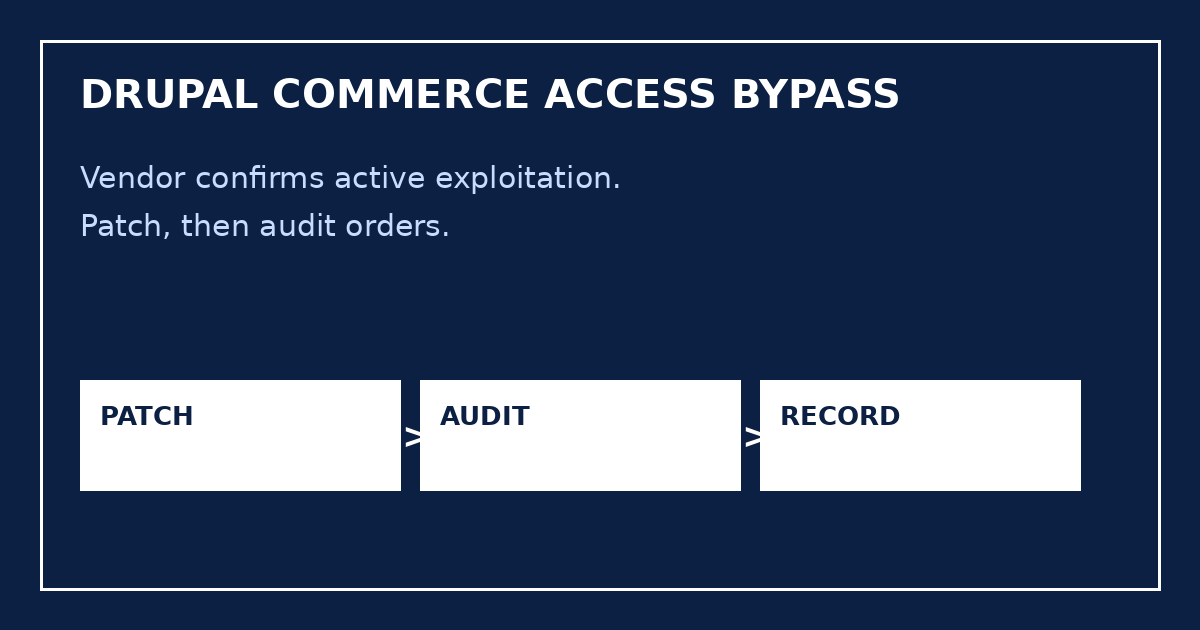
A component inside the boundary carries the boundary's risk. A commerce module with an exploited bypass is that component. Your file must show the fix and the check behind it.
The flaw in plain words
Drupal published advisory SA-CONTRIB-2026-254 on October 28, 2026. The flaw is an access bypass in Commerce Core. The record is CVE-2026-118539. The Common Vulnerabilities and Exposures (CVE) system holds the public record. An attacker without a login can reach protected order fields. Drupal states the flaw is actively exploited in the wild. Fixed releases are Commerce Core 3.3.13 and 8.x-2.41.
What the file must show
First, the component inventory entry for Commerce Core. Second, the installed release before the patch. Third, the fixed release and the patch date. Fourth, the scan result after the patch. Fifth, the order audit result. Keep the item open until the patch and the audit both close. Closing on the patch alone leaves the audit undone. A monitoring note should name the next check date.
What is not confirmed
Drupal gives no attacker name and no victim count. It gives no attack volume for this flaw. Do not claim a wider impact than the advisory states. The Cybersecurity and Infrastructure Security Agency (CISA) tracks exploited flaws. CISA has not listed this flaw as of November 1, 2026.
PolicyCortex does not patch Drupal modules. PolicyCortex helps teams link proof to requirements.
Sources
- CVE-2026-118539 record, CVE Program
- Drupal security advisory SA-CONTRIB-2026-254, October 28, 2026. https://www.drupal.org/sa-contrib-2026-254
- Original diagram by PolicyCortex
Next step
Keep the flaw open in your file until the audit closes.