Questions / Answer
How Do I Describe Shared Services in a FedRAMP Authorization Package?
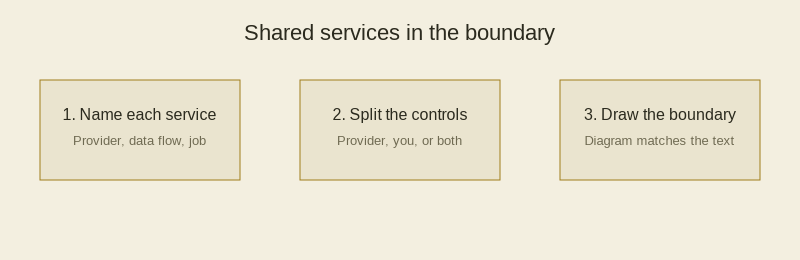
Your product runs on a shared database, a shared login service, and a shared logging tool. Your authorization package must say so, and it must say who guards each one. Assessors look for that list first.
Federal Risk and Authorization Management Program (FedRAMP) is the program that authorizes cloud services for federal use. A cloud service provider (CSP) writes a System Security Plan (SSP) to describe the service. NIST Special Publication 800-18 Revision 1 is the guide for writing that plan.
FedRAMP Authorization Boundary Guidance sets the line for what sits inside the review. A service sits inside the boundary if it handles federal information. It also sits inside if it can change the safety of that information. A shared service that meets either test belongs in the package.
Name each shared service
List every shared service your product uses. Name the service, the provider, and the job it does. A login service checks who signs in. A logging service stores the audit trail. A database stores the data. Name each one in plain words.
For each service, write what data flows to it. Write what flows back. Write how the two sides check each other. A connection with no description is a gap the assessor will flag.
Say who guards what
Split the controls for each shared service. Some controls belong to the provider. Some belong to you. Some belong to both. Write the split in a shared responsibility matrix. The matrix is a table with one row per control and one owner per row.
A provider that holds its own FedRAMP authorization can pass its controls to you. That is called inheritance. Name the provider authorization and the date it was granted. Do not claim a control you did not check. If the provider authorization lapses, your inherited controls lapse with it.
Draw the boundary diagram
Draw the boundary around your service and each shared service inside it. Show the data flow with arrows. Show the checks at each crossing. The diagram must match the written description. An assessor reads the diagram first and the text second. If the two disagree, the diagram loses.
Keep corporate shared services out of the boundary when they do not touch federal information. Email, office tools, and dev systems stay out if a loss there cannot harm federal data. Write one line that says why each one stays out. Silence looks like an omission.
What to do this week
List the shared services your product uses today. For each one, write the provider, the data flow, and the control owner. Then draw a rough boundary diagram and check it against the list. Fix any service that appears in one place and not the other.
Sources
- FedRAMP Authorization Boundary Guidance, Federal Risk and Authorization Management Program.
- NIST SP 800-18 Revision 1, National Institute of Standards and Technology.
- NIST SP 800-37 Revision 2, National Institute of Standards and Technology.
- Original diagram by PolicyCortex.
Next step
Want your authorization evidence tied to live systems? See how PolicyCortex collects it automatically.