Questions / Answer
How Do I Prepare for a FedRAMP Readiness Assessment?
Your cloud service works, but you do not know if it is ready for a formal review.
FedRAMP means Federal Risk and Authorization Management Program. CSP means cloud service provider. A CSP is the company that sells the cloud service. 3PAO means Third-Party Assessment Organization. A 3PAO is an independent assessor. CSO means cloud service offering. RAR means Readiness Assessment Report.
What a readiness assessment is
A readiness assessment is an early check, not a full authorization. A 3PAO reviews your service before a formal authorization starts. The 3PAO writes a RAR. The RAR states whether you are ready to proceed.
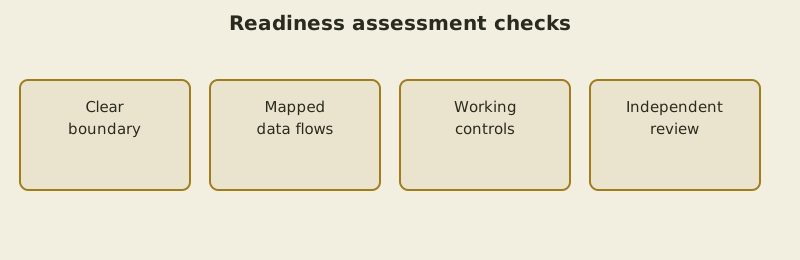
FedRAMP guidance for the RAR sets the bar clearly. Technical controls should be in place and working. The full SSP need not be finished yet. SSP means System Security Plan. The boundary must be clear. Data flows must be documented. That guidance is in the 3PAO Readiness Assessment Report Guide.
Do not treat readiness as a paperwork exercise. A polished draft cannot pass a control that does not work. A working control with a short note can pass.
Draw the boundary first
The boundary is the line around your service. Everything inside the line is in scope. Everything outside the line is out of scope. A fuzzy boundary fails readiness fast.
List every component inside the boundary. List servers, databases, networks, and shared services. List every external service you connect to. Name each connection and the data it carries.
Draw the boundary on one diagram. Show each component as a box. Show each connection as a line. Label each line with the data type. If you cannot draw it, you do not know it yet.
Map every data flow
The RAR must account for all federal data flows. That includes flows inside the boundary. It includes flows across the boundary. It includes flows to external systems.
Build a flow list before the assessor arrives. For each flow, name the source. Name the destination. Name the data type. Name the protection in transit.
Check the list against the diagram. Every line on the diagram needs a row in the list. Every row in the list needs a line on the diagram. A missing flow is a common readiness finding.
Prove controls work, not just exist
Pick the controls that guard federal data first. Access control, logging, patching, and incident response come first. For each control, gather three items. The policy that requires it. The setting that enforces it. The record that proves it ran.
Test each control yourself before the 3PAO tests it. Try a login without the second factor. It should fail. Check a log for a recent event. It should be there. Check a patch record for a recent fix. It should be dated.
Fix what fails before the assessment starts. A fix found by you is a strength. The same fix found by the assessor is a finding.
Prepare the people and the evidence room
The 3PAO will ask your staff how controls work. Rehearse short answers for each control owner. Each answer needs a name, a step, and a record. Keep answers under one minute.
Build one evidence folder for the assessment. Use one subfolder per control family. Put only current records inside. Remove drafts and old versions. A clean folder speeds the review and builds trust.
Choose the path after readiness
Readiness does not grant authorization. It tells you if you are ready to seek it. FedRAMP changed its authorization paths in 2026. Check the current path before you plan next steps. The current rules are in the FedRAMP Consolidated Rules for 2026.
If the RAR finds gaps, fix them in priority order. Boundary gaps come first. Data flow gaps come next. Working control gaps come last. Then ask the 3PAO to recheck the fixed items.
Next step
This guide is an independent explainer, not a FedRAMP statement. PolicyCortex is not FedRAMP authorized. PolicyCortex collects evidence from live Azure configuration with 33 collectors. The collectors read conditional access, diagnostic settings, Defender posture, backup, and firewall. The evidence is evaluated against NIST 800-53 and NIST 800-171. NIST means National Institute of Standards and Technology. That evidence supports re-verification after remediation. SAR means Security Assessment Report. POA&M means Plan of Action and Milestones. It generates SSP, SAR, and POA&M output from collected evidence. AWS means Amazon Web Services. PolicyCortex is strongest in commercial Azure, and AWS is covered. Start at policycortex.com.
Sources
- FedRAMP 3PAO Readiness Assessment Report Guide. https://www.fedramp.gov/resources/documents/rev4/REV_4_3PAO_Readiness_Assessment_Report_Guide.pdf
- FedRAMP Consolidated Rules for 2026. https://www.fedramp.gov/2026/providers/20x/rules/fedramp-certification/
- NIST SP 800-53 Revision 5, Security and Privacy Controls for Information Systems and Organizations. https://csrc.nist.gov/pubs/sp/800/53/r5/upd1/final
- Diagram: original by blog.fedramp.net.