Questions / Answer
UpdraftCentral and FedRAMP Supply Chain Expectations
FedRAMP expects cloud service providers to manage supply chain risk and to report incidents. UpdraftCentral shows what those obligations look like in practice.
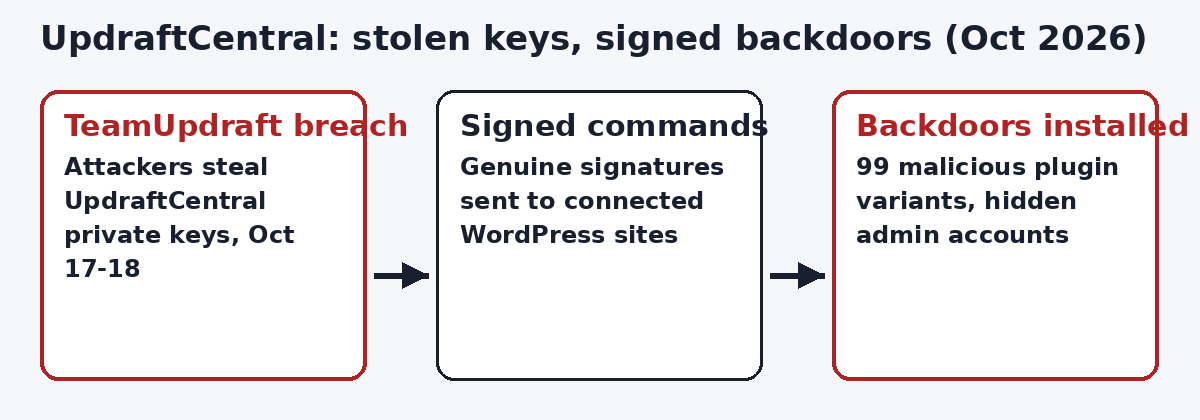
Over the weekend of October 17 and 18, 2026, attackers broke into TeamUpdraft's website. They stole the private keys behind UpdraftCentral, the remote management service for UpdraftPlus. They sent commands to connected WordPress sites and installed backdoor plugins with real signatures.
Security firm Nethemba found the campaign on its own servers. Security firm Patchstack counted 99 malicious plugin names installed between 15:32 UTC on October 18 and 09:23 UTC on October 19.
The provider obligations
FedRAMP's supply chain guidance expects providers to know their suppliers and to assess the risk they carry. A vendor that holds signing keys over customer systems is a high consequence supplier relationship.
The incident response obligations expect providers to detect, contain, and report. TeamUpdraft's response is the reference: it confirmed the breach on October 19, closed the access route, rotated keys, reported to the United Kingdom's Information Commissioner's Office, and shipped fixes.
The fix history also matters. Version 1.26.12 was meant to revoke the old keys but did not delete them. Versions 1.26.13 and 2.26.13 fixed the revocation. Honest fix timelines belong in the evidence.
The agency view
Agencies consuming cloud services inherit the provider's supply chain. The authorization package should show that the provider tracks its own suppliers and their incident history.
When a provider's vendor is compromised, the agency question is simple: did our data or systems touch the affected channel? The answer needs an inventory, not a guess.
What good evidence looks like
Provider evidence for this class of event includes the supplier inventory, the incident timeline, the affected customer list, and the remediation record.
For UpdraftCentral specifically, the remediation record must cover the manual deletion window. Keys created between 12:07 and 21:00 UTC on October 18, 2026 survive the vendor's update. They must be deleted by hand. A record that says "updated" without the manual check is incomplete.
What to do this week
Providers: review your supplier inventory for vendors that hold signing or management access over your systems. Agencies: ask your providers whether any supplier incident touched your boundary.
Add vendor incident disclosures to the continuous monitoring inputs. The next one will not wait for a CVE.
Sources
- Security incident disclosure, TeamUpdraft, October 19, 2026. Vendor's primary incident statement.
- "Stolen UpdraftCentral Keys Are Backdooring WordPress Sites," Patchstack, October 19, 2026. https://patchstack.com/articles/updraftcentral-key-compromise-wordpress-backdoors/
- Campaign analysis, Nethemba, October 19, 2026. First detailed researcher analysis of the campaign.
- FedRAMP guidance on supply chain risk management. https://www.fedramp.gov
- Original diagram by PolicyCortex.
Next step
Want supplier risk evidence collected from the live environment? See how PolicyCortex collects it on Azure.