Questions / Answer
What do people get wrong about FedRAMP?
You are building a cloud product for federal buyers, and the advice around you is full of holes.
FedRAMP means Federal Risk and Authorization Management Program. It judges whether cloud services are safe enough for federal agencies to use.
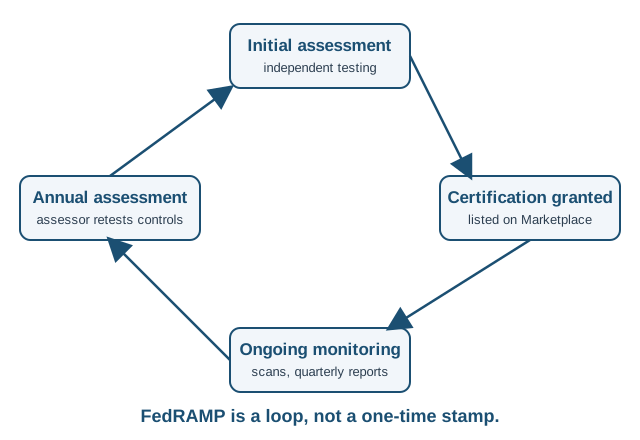
Wrong: FedRAMP is a one-time certificate
FedRAMP is not a finish line. Certified offerings must keep proving their security over time.
The program expects ongoing certification reports, quarterly reviews, and annual independent assessments. (FedRAMP 2026 changelog)
Think of it as a loop, not a stamp. Missing the recurring work can cost you the certification.
What to do: budget for monitoring from day one. Plan the people and tools that will run scans and file reports every month, long after the first assessment ends.
Wrong: FedRAMP certifies your whole company
Each certification covers one CSO. CSO means cloud service offering, one specific product or service.
The certification names the product, not the company that sells it. Your company can hold a certification for one product while another product has none.
What to do: write down exactly which product needs certification. Draw the boundary around it before you spend anything.
Wrong: every federal IT system needs it
FedRAMP covers cloud service offerings used by federal agencies. That is its whole scope.
Systems an agency builds and runs itself fall under a different law. That law is the Federal Information Security Modernization Act, called FISMA. FedRAMP deals exclusively with cloud service offerings, while FISMA covers agency systems broadly. (CMS FedRAMP explainer)
The rule of thumb: if your cloud service holds federal data, FedRAMP applies to it. If the agency built the system itself, FISMA applies instead.
What to do: figure out whose system it is first. That answer tells you which program governs it.
Wrong: FedRAMP Ready meant authorized
Ready was always an entry badge, never an authorization. No agency could buy a service on the Ready badge alone.
On July 28, 2026, FedRAMP retired the Ready designation. No new Ready submissions are accepted after that date. (FedRAMP timeline of important dates)
The current entry path is a 20x Class A certification. 20x is the name of FedRAMP's modernized certification program. The Class A pipeline opened on August 3, 2026.
What to do: if any vendor still sells you on being "FedRAMP Ready," ask what certification class they hold now. The old label no longer exists.
Wrong: my cloud provider's certification covers my app
If your app runs on a certified cloud platform, that certification covers the platform. It does not cover your app.
Your own offering still needs its own certification. Each agency that buys from you will review your security package, not just your provider's.
What to do: map which security duties your provider handles and which ones fall on your app. Then certify your app.
Wrong: FedRAMP is fast and cheap
Plan for a long project and a real budget. The assessment work, the 3PAO review, and the ongoing monitoring all cost time and money.
A 3PAO is a Third Party Assessment Organization, the independent assessor that tests your product.
FedRAMP's own timeline page lists hard dates you must plan around. The Consolidated Rules for 2026 take mandatory effect on January 1, 2027. (FedRAMP timeline of important dates)
What to do: read the current rules at fedramp.gov/2026 before trusting any guide from before 2026. Then set a budget that includes the annual reassessments, not just the first one.
A note on PolicyCortex
This site explains FedRAMP independently. PolicyCortex is a commercial compliance platform for NIST 800-171 and CMMC evidence. NIST means National Institute of Standards and Technology. PolicyCortex is not FedRAMP authorized, and nothing here claims otherwise.
Next step
PolicyCortex collects evidence from live Azure configuration using 33 collectors. The collectors read conditional access, diagnostic settings, Defender posture, backup, and firewall. The evidence is evaluated against NIST 800-53 and NIST 800-171. It supports re-verification after remediation. It generates SSP, SAR, and POA&M output from collected evidence. SSP means System Security Plan. SAR means Security Assessment Report. POA&M means Plan of Action and Milestones. PolicyCortex is strongest in commercial Azure, and AWS is covered. Start at https://policycortex.com.
Sources
- FedRAMP Consolidated Rules for 2026, official changelog, release dated October 14, 2026. https://www.fedramp.gov/2026/changelog/
- FedRAMP, Important Dates, Consolidated Rules for 2026 timeline. https://www.fedramp.gov/2026/timeline/
- CMS, "Federal Risk and Authorization Management Program (FedRAMP)," FedRAMP versus FISMA. https://security.cms.gov/learn/fedramp