Questions / Answer
What Evidence Supports FedRAMP Vulnerability Scanning Requirements?
Your monthly scan is only as good as the file you hand to the reviewer. A scan with gaps reads like no scan at all.
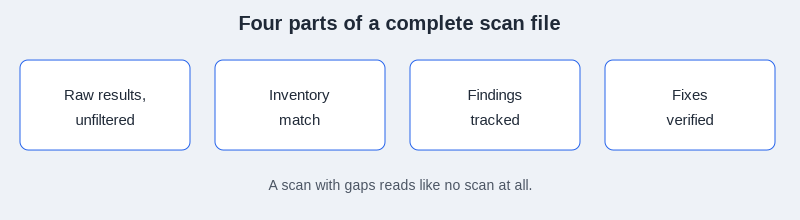
FedRAMP means Federal Risk and Authorization Management Program. ConMon means continuous monitoring. RA-5 means the NIST control for vulnerability monitoring and scanning. NIST SP 800-53 Revision 5 defines RA-5. The FedRAMP Continuous Monitoring Playbook gives the scanning guidance for authorized services.
What the scan must cover
Scan operating systems and infrastructure each month. Scan web applications and databases on the FedRAMP schedule for those parts. Use a scanner fit for each part. A network scanner does not test a web application well. A web scanner does not test a database well.
Scan the full inventory, not a sample, unless an approved sampling plan applies. An approved plan must name the unique inventory items, and the assessor must agree it represents the set. Externally reachable parts should get full scans, not sampled scans.
The four parts of a complete scan file
First, the raw scan output, unfiltered. Do not hide low findings before you submit. A reviewer must see what the scanner saw.
Second, an inventory match. Every finding must tie to an asset in your inventory. A finding tied to no asset means your inventory is incomplete. Fix the inventory, then resubmit.
Third, a tracked finding for each real issue. Put each finding on your POA&M. POA&M means Plan of Action and Milestones. Give each finding a severity, an owner, and a due date.
Fourth, proof that each fix was verified. A closed ticket alone is weak proof. A rescan showing the finding is gone is strong proof. Keep both, and link the rescan to the original finding.
How to handle findings that are not real
Some scanner hits are false positives. Some hits are informational, with no risk rating. Treat them differently, and write the difference down.
For a false positive, record why the hit does not apply. Name the check you ran to prove it. During monthly monitoring, file a deviation request for that finding. Do not just delete it from the file.
For an informational hit, record that it holds no risk rating. FedRAMP guidance treats informational hits as no risk, so they need no POA&M entry. Keep the note, so a reviewer does not reopen the question later.
The monthly rhythm that keeps evidence clean
Run the scan. Match it to inventory the same week. Open POA&M entries for real findings. Verify fixes with a rescan. Submit the scan file, the updated POA&M, and the inventory together. A late inventory match is the most common cause of a returned file.
Sources
- FedRAMP Continuous Monitoring Playbook.
- NIST SP 800-53 Revision 5.
- Original diagram by PolicyCortex.
Next step
Want evidence tied to each control from live systems? See how PolicyCortex collects it.