Questions / Answer
What Happens During a FedRAMP Significant Change Request Review?
You plan a change to your authorized cloud service. The change is big enough to affect security. Now a review stands between your plan and your launch date. Here is how that review works.
What counts as significant
FedRAMP means Federal Risk and Authorization Management Program. It is the government program for authorizing cloud services. A significant change is one that can affect the security state of your service.
Adding a new component usually counts. Changing your authorization boundary usually counts. A boundary is the line around what is in scope. Adding a new interconnection usually counts too. Routine patching and small config tweaks usually do not count.
If you are unsure, ask early. Guessing wrong can put your authorization at risk.
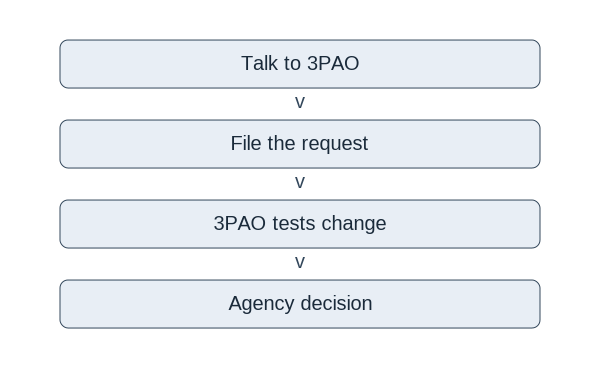
Step one: talk to your assessor
Your assessor is a 3PAO. 3PAO means Third-Party Assessment Organization. It is the independent body that tests your service.
Meet the 3PAO before you build anything. Describe the change, why you need it, and what it touches. The 3PAO helps you decide if a formal request is needed at all.
Bring a Security Impact Analysis to that meeting. That is a short paper on what the change affects. It lists controls touched, risks added, and risks removed. A clear analysis makes the whole review faster.
Step two: file the request
If the change is significant, you file a Significant Change Request. SCR is short for Significant Change Request. The request describes the change in full. It names the systems, controls, and boundary parts affected. It states the planned dates.
Your agency customer reviews the request with you. The agency is the federal customer that sponsored your authorization. The agency must agree the change is safe to assess. Do not start building the change before that agreement, unless the agency says you may.
Note that FedRAMP has been moving toward a notification model for changes. Under the newer Significant Change Notification standard, some changes need notice rather than prior approval. Check the current FedRAMP guidance before you file, so you use the path that applies to your authorization (FedRAMP Significant Change Notification Standard).
Step three: assessment of the change
The 3PAO tests only what the change touches. It does not redo your whole authorization. It tests the new component, the changed controls, and the new connections.
You provide evidence for the changed parts. That means configs, scan results, and test records for the new scope. Old evidence for untouched parts still stands.
If testing finds a gap, you fix it and retest. The review does not move forward with an open gap in the changed scope.
Step four: decision and update
The 3PAO writes up its findings. The agency reviews those findings. If the agency agrees, your authorization continues with the change included. Your package gets updated to match the new state.
Update your System Security Plan at this point. SSP means System Security Plan. It must describe the service as it now runs, not as it ran before. A stale plan will hurt your next annual assessment.
How to plan around the review
Put the review on your roadmap as early as the change itself. Do not lock a customer launch date before the review is done. A review takes time, and its length depends on scope.
Keep the change small when you can. A narrow change means a narrow review. A wide change means a wide review and more test evidence.
This article explains FedRAMP only. It does not claim any authorization for PolicyCortex. PolicyCortex is a commercial compliance product, not a FedRAMP authorized service.
Next step
PolicyCortex collects evidence from live Azure configuration using 33 collectors. The collectors read conditional access, diagnostic settings, Defender posture, backup, and firewall. The evidence is evaluated against NIST 800-53 and NIST 800-171. It supports re-verification after remediation. It generates SSP, SAR, and POA&M output from collected evidence. SAR means Security Assessment Report. POA&M means Plan of Action and Milestones. PolicyCortex is strongest in commercial Azure, and AWS is covered. Start at https://policycortex.com.
Sources
- FedRAMP Significant Change Notification Standard, FedRAMP. https://www.fedramp.gov/rfcs/0007/
- NIST SP 800-53 Revision 5, Security and Privacy Controls for Information Systems and Organizations, National Institute of Standards and Technology. https://doi.org/10.6028/NIST.SP.800-53r5