Questions / Answer
What Is Control Inheritance in FedRAMP, and How Do I Document It in My SSP?
Your cloud provider already runs some controls you rely on. You do not need to rebuild those controls yourself. You do need to document them clearly, or an assessor cannot count them.
FedRAMP means Federal Risk and Authorization Management Program. CSP means cloud service provider. SSP means System Security Plan. 3PAO means Third Party Assessment Organization. This site is an independent explainer. It is not affiliated with FedRAMP. PolicyCortex is not FedRAMP authorized.
What inheritance means
Control inheritance means you rely on a control your provider already operates and has validated. A common example is physical security at a data center. Your provider guards the building, so you inherit that control. You still own the controls inside your own service, such as managing your own user accounts.
Inheritance only works inside the provider boundary. The boundary is the set of parts the provider authorization covers. If your service uses a provider part outside that boundary, you cannot inherit controls from it. Check the boundary first, before you claim any inherited control.
Inheritance also depends on your settings. A provider can offer a secure service that you then configure in an unsafe way. In that case, the inherited control no longer holds for your service. Your SSP must describe your settings, not just name the provider.
Document it in the SSP
The FedRAMP SSP template requires a clear account of inherited controls. The FedRAMP authorization playbook describes the SSP as the central package document that assessors test from. Use that template, and fill the inheritance parts fully. A vague line like "inherited from our provider" will not pass review.
For each inherited control, write four items. First, the control identifier, such as the NIST SP 800-53 control number. NIST means National Institute of Standards and Technology. Second, the provider name and the provider service. Third, the provider authorization that covers it. Fourth, what you still do yourself to keep the inheritance valid.
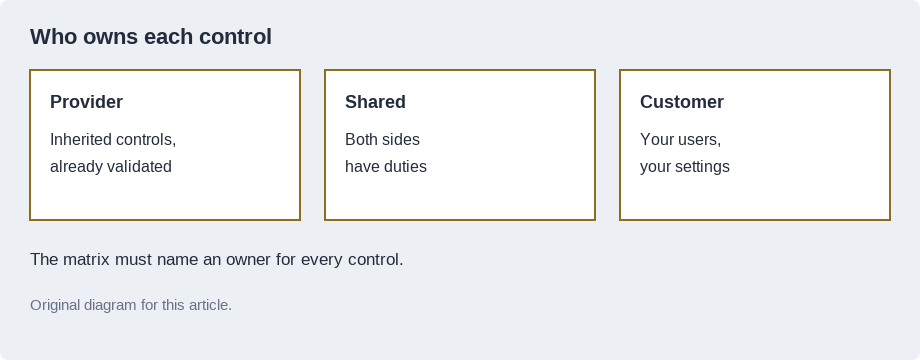
Then build a Customer Responsibility Matrix. CRM means Customer Responsibility Matrix. The matrix lists each control and marks it as provider owned, customer owned, or shared. A shared control needs duties on both sides, written out. For example, backup may be shared. The provider backs up the platform. You back up your own data and test restores.
What assessors check
A 3PAO tests inherited controls by checking your side of the deal. The assessor will ask for the provider authorization record. The assessor will ask how your settings match the provider requirements. The assessor will test the controls you own, not just read about the ones you inherit.
Watch for three common errors. The first error is claiming a control the provider does not actually cover. The second error is copying provider text into your SSP without describing your own use. The third error is leaving a control with no owner at all. Each error forces rework, because the assessor cannot test a control with a missing owner.
Keep inheritance current
Providers change services, regions, and authorization scope over time. Recheck your inheritance list when your provider announces a change. Recheck it at least once a year, even with no announcement. If a provider control leaves scope, own that control yourself. Or find a new provider part that covers it. Update the SSP and the matrix on the same day you learn of the change. A stale matrix is worse than a short one, because it points assessors at proof that no longer exists.
Next step
PolicyCortex collects evidence from live Azure configuration using 33 collectors. The collectors read conditional access, diagnostic settings, Defender posture, backup, and firewall. The evidence is evaluated against NIST 800-53 and NIST 800-171. It supports re-verification after remediation. It generates SSP, SAR, and POA&M output from collected evidence. SAR means Security Assessment Report. POA&M means Plan of Action and Milestones. PolicyCortex is strongest in commercial Azure, and AWS is covered. Start at https://policycortex.com.
Sources
- FedRAMP CSP Authorization Playbook, Getting Started with FedRAMP, Federal Risk and Authorization Management Program. https://www.fedramp.gov/resources/documents/rev4/REV_4_CSP_Authorization_Playbook_Getting_Started_with_FedRAMP.pdf
- NIST SP 800-53 Revision 5, Security and Privacy Controls for Information Systems and Organizations, National Institute of Standards and Technology. https://doi.org/10.6028/NIST.SP.800-53r5
- NIST SP 800-18 Revision 1, Guide for Developing Security Plans for Federal Information Systems, National Institute of Standards and Technology. https://doi.org/10.6028/NIST.SP.800-18r1